$6.6 million separates two proposed sites — and the clock is ticking
PORT ALLEN — The city’s search for a new sewer treatment plant came down to two properties and one question Monday night: Is saving $6.6 million worth building closer to a neighborhood?
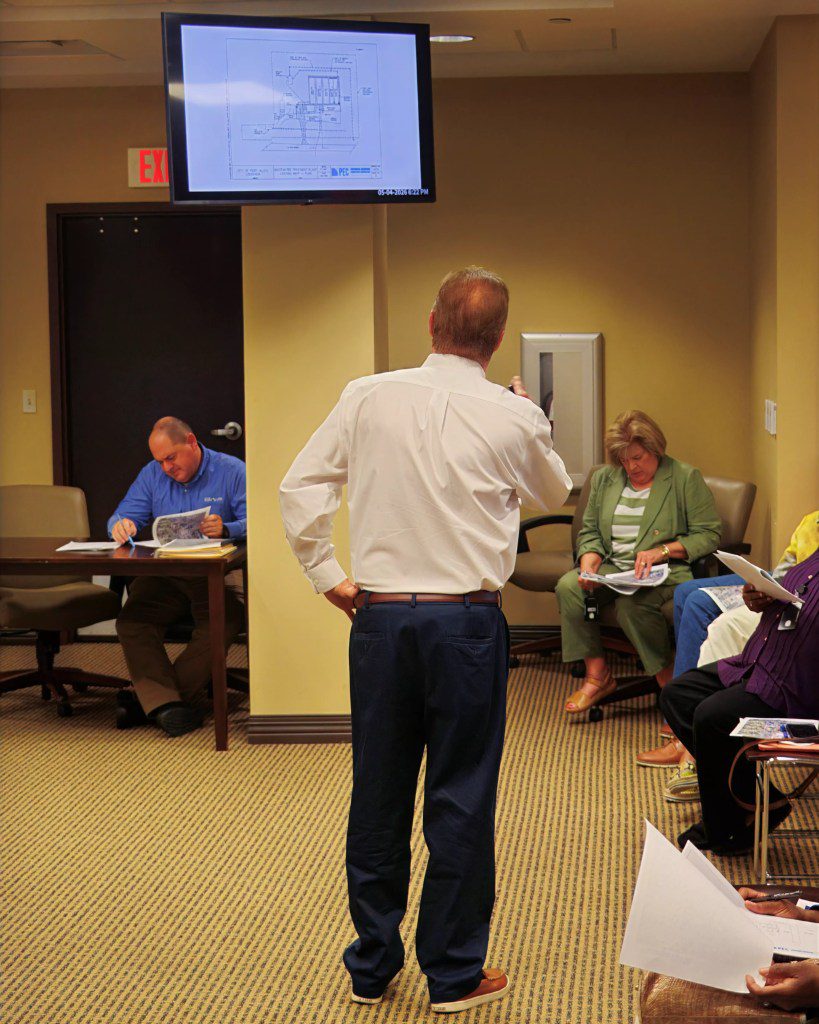
Mayor Terecita Pattan hosted her third town hall meeting at City Hall on May 4, this time focused entirely on the proposed sewer plant replacement. It was the largest turnout of the three town halls, driven by door hanger notices distributed to streets in the area most likely to be affected.
“We’ve heard rumors and concerns about the property that we are looking at for the proposed new sewer plant,” Pattan told the crowd. “You can’t go by what you hear. We wanted to get some feedback from our citizens.”
The two options
City engineer Tony Arikol, president of Professional Engineering Consultants Corporation, a division of Forte and Tablada, presented engineering exhibits showing both sites. Neither site has been designed or selected, he said. The purpose of the meeting was to hear from residents before any decision is made.
Option 1 is a roughly 30-acre parcel owned by Boulanger Properties LLC, located behind Harry Brown Street off Allendale Road. According to PEC’s engineering exhibits, the new plant would sit approximately 472 feet from the nearest homes if placed near the center of the property. Piping to connect the new plant to the existing influent and effluent infrastructure would run about 5,100 feet each way, at an estimated cost of approximately $3 million. The property is within city limits.
Option 2 is a similarly sized parcel further down Court Street near Turner Road, adjacent to the Westview Crossing subdivision and the parish multi-purpose center. That site would require roughly 17,900 feet of piping each way, at an estimated cost of approximately $9.6 million.
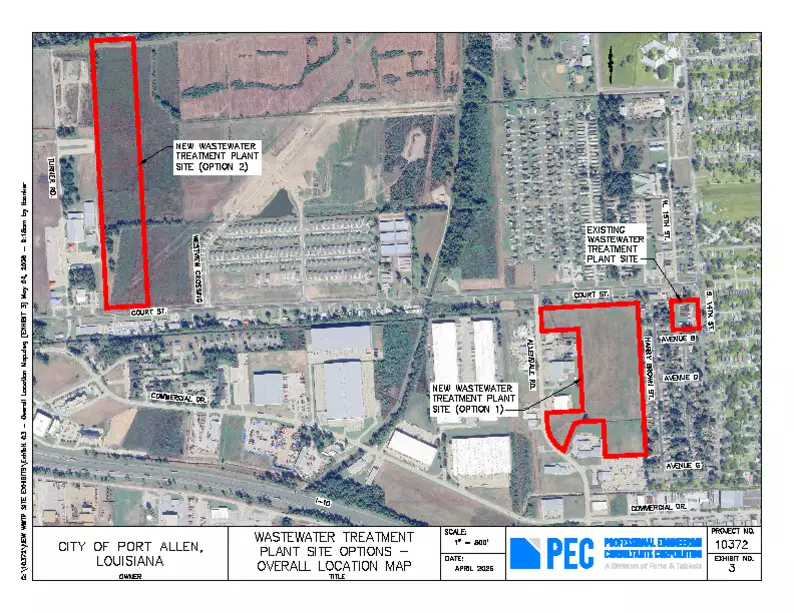
The difference in piping alone is $6.6 million. The treatment plant itself would be identical at either location.
The property behind Harry Brown is priced at roughly $2.7 million, according to Pattan. She said the seller is ready to move and has a competing buyer from Texas interested in the land.
But Option 2 carries a risk beyond cost. Councilwoman Charlene Gordon pointed out that the Court Street property is located in the parish, not the city, and would require rezoning approval from the parish government — something that is not guaranteed.
“You can go buy that property right now, and you think we’re going to approve it because you bought it,” Gordon said, referencing a past instance where the city purchased property without securing approval first. “We’ll say no. And you’re stuck with property.”
Why the city says it can’t wait
The existing plant was built in 1960 and runs 24 hours a day. According to Arikol, the city has spent approximately $1.5 to $1.6 million on emergency repairs over the past five years with no lasting benefit.
“It’s like buying a really old house that’s already termite ridden,” one of the city’s sewer department workers told the crowd. “All you’re going to do is just keep it from falling down. And that’s kind of what I feel like we’re doing now.”
Sewer Supervisor Filmore “BJ” Bradford Jr. was more direct. Asked what happens if the current plant keeps running as-is, he said the city is approaching a breaking point.
“Everybody in the city will be calling DEQ. We’ll be all over the news,” Bradford said. “I mean, that’s almost right there, right now.”
Bradford told residents the equipment runs around the clock and has for 66 years. He said a new plant would operate more efficiently, with modern equipment that produces less noise and fewer odors. He estimated a new facility could run reliably for about 15 years before needing major work.
When asked whether he had a preference between the two sites, Bradford said it did not matter to operators where the plant goes, but endorsed the closer option for practical reasons.
“Me personally, my personal opinion — the closer the better,” Bradford said.
Residents push back — and share their own problems
Not everyone agreed.
One longtime resident said he was against placing another sewer facility near the neighborhood. He recalled a past councilman telling him the city once owned property near the large warehouses off Commercial Drive but sold it.
“We don’t need another sewer plant in the neighborhood,” he said.
James, a 42-year resident of Harry Brown Street, described a drainage ditch behind the homes that was graded over when trees were removed from the Boulanger property. He said the ditch once carried water to a drain pipe, and without it, backyards are now flooding.
“Before all the trees was there, there was no water on those houses,” James said. “They had a ditch there. That water used to run in that ditch. When they graded it, it covered the ditch up.”
Pattan acknowledged the drainage problem, saying she saw standing water on the property earlier that day. But she said the city’s hands are tied as long as the land belongs to someone else.
“We can’t make them grade the property,” Pattan told residents, referring to the current property owners. “We can’t make them fix it.”
She said the city could either dig a trench or run piping to address the flooding, but both options are expensive and may only be temporary. If the city owned the property, she said, a permanent fix would be far more straightforward.
“If we own the property, then of course that would be easier to fix,” Pattan said. “If not, I’m just not sure it’ll be a permanent fix.”
Bradford echoed the point, telling the crowd that purchasing the Boulanger property would let the city solve the drainage and the sewer problem at the same time.
“The people that’s having flood problems — we own the land, we could build a big fence, there’s things that you can do to make it better for them,” Bradford said. “You kill two birds with one stone.”
A resident of Avenue G described a different problem — daily sewage backups in her home. She said wastewater backs up into her bathtub every morning, requiring more than an hour of plunging before she can shower. Her floors have buckled and her baseboards are ruined.
“It’s every day for me,” she said.
Arikol said a roughly $1 million pipeline rehabilitation project is planned for the summer, which will include camera inspections to identify the worst problem areas. He asked affected residents to provide their addresses to Bradford’s team so the worst streets can be prioritized.
Arikol noted that City Hall’s first-floor bathrooms are experiencing the same backup issues.
A Colonial Drive resident offered a different perspective, telling the crowd she lives near the newer Esperanza subdivision treatment plant and does not hear or smell it.
“I do not hear the treatment plant. I do not smell anything,” she said. “They went a long way with treatment plants since 1960.”
What comes next
No vote was taken Monday night, and none was expected. The meeting was designed to gather public input before the city moves forward.
Pattan said she plans to follow up with the property owner about a possible four-acre parcel at one corner of the property that could be sold separately, which would reduce the city’s purchase cost.
Arikol said a buffer zone with fast-growing trees or landscaping would be included at either site, similar to a recent plant PEC designed in St. Francisville. He said the plant footprint itself is roughly 150 by 250 feet — far smaller than either 30-acre property.
Several residents asked to be notified when a decision goes before the council. Pattan agreed.
The city’s sewer plant replacement has been discussed for roughly eight to 10 years, according to Arikol. In April, the city rejected all six bids on a related sewer project after every bid came in over budget. The city also approved a sewer budget amendment and suspended late fees at a special meeting on April 1.

Leave a Reply