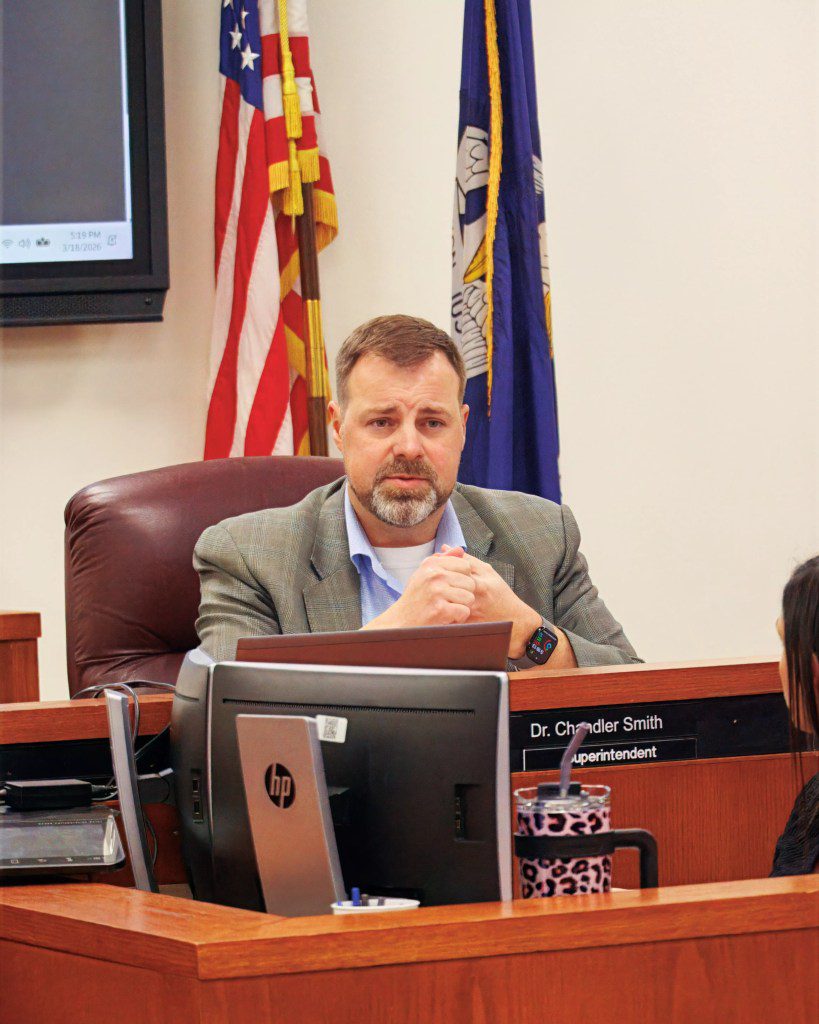
PORT ALLEN — A former Port Allen High School special education teacher is suing the West Baton Rouge Parish School System and Superintendent Dr. Chandler Smith, claiming the district fired her in retaliation for reporting that a paraprofessional was bullying a student with disabilities.
Melissa Durham filed the lawsuit on March 27 in 18th Judicial District Court, representing herself. The case, assigned to Judge Tonya S. Lurry, is docketed as C-1051032. Durham’s application to waive filing costs was denied, meaning she funded the suit out of pocket.
The 43-page petition seeks reinstatement to her former position, removal of disciplinary notations from her personnel file, and compensatory and punitive damages — including punitive damages against Smith in his individual capacity.
“We don’t comment on pending litigation,” Superintendent Smith wrote in an email to WBR Independent on April 22.
Board attorney Evan Alvarez responded separately, stating that “the School Board will defend itself in this matter and looks forward to its day in court.”
Principal Jakouri Williams and School Board President Matthew Daigrepont did not respond to requests for comment.
A classroom without enough help
Durham was hired in August 2024 as a self-contained special education teacher at Port Allen High School. Self-contained classrooms serve students with the most significant disabilities, and state law requires specific paraprofessional-to-student ratios to ensure safety and compliance with individualized education plans.
According to the petition, Durham began the 2025-2026 school year with eleven students on her caseload and one paraprofessional assigned for only half the day. On August 9, 2025, Durham emailed Principal Jakouri Williams requesting additional paraprofessional support, writing that her classroom was “not in compliance with state requirements.”
“There is supposed to be one teacher and two paras for 6 students, and another para for each additional 3 students,” Durham wrote in the email, which is included as part of the court filing. “My caseload has those ‘lawyering up’ types of parents.”
The petition states that neither Williams nor the special education instructional specialist responded to her request. Five days later, according to the filing, the first act of retaliation began — a conference about a student riding in Durham’s personal vehicle, an issue that had been permitted under the previous administration.
Reporting the bullying
The lawsuit describes a pattern of conflict between Durham and a paraprofessional assigned to her classroom.
According to the filing, Durham first reported concerns about the paraprofessional’s treatment of a student in April 2025. Durham told administrators the paraprofessional had denigrated the student, but the complaint went unaddressed.
The situation escalated in December 2025, when Durham reported a second incident. The petition states that the paraprofessional confronted the student so aggressively that the student “cried so hard she had nasal phlegm all over her face,” after which the paraprofessional told her to “stop crying and go clean her face.”
Durham reported the incident by email to Williams, the student’s IEP teacher, and the student’s parents on December 10, 2025. According to the petition, what followed was not an investigation — but retaliation.
The timeline tightens
The filing lays out a sequence of events that Durham argues shows the district’s true motive:
After the December 2025 report, both of Durham’s part-time paraprofessionals stopped assisting in her classroom, according to the petition. Durham alleges this left her as the sole adult with ten self-contained students — in violation of state staffing requirements.
On January 30, 2026, Williams called Durham into a meeting with Assistant Principal Michelle Takada. According to the filing, Williams read accusations from a prepared document and dismissed Durham’s attempts to explain.
On February 9, Smith sent Durham a letter citing four incidents as grounds for potential termination. Durham responded in a timely manner, according to the petition, arguing that each incident was connected to the lack of paraprofessional support in her classroom and that her actions reflected professional judgment.
On February 10, Durham took a sick day and filed for short-term medical leave through One America, the district’s leave administrator.
On February 17, One America formally notified the district that Durham had filed for medical leave.
On February 18 — one day later — Smith recommended Durham for termination.
The petition states that the district then pressured Durham “to resign or retire numerous times a day over weeks” while she was on medical leave, giving her what she described as “unrealistic deadlines” to make life-changing decisions. A formal retirement and resignation agreement was sent to Durham by Barbara Burke, the district’s HR director, on March 3.
Durham declined. On March 12, 2026, Smith issued the termination letter. The letter was dated March 12 but listed the effective date of termination as March 11 — one day before the letter itself. That date, the petition notes, was also the last day of Durham’s accrued paid time off.
Durham also noted that the language in Smith’s termination letter had escalated from the February 9 disciplinary letter. Where the earlier letter described Durham as having “talked to students,” the termination letter characterized the same interaction as “yelling” — a change Durham argued was evidence the district was strengthening its narrative after the fact.
Three of four reasons trace to one parent
The petition challenges the district’s stated reasons for termination, arguing that three of the four cited incidents trace back to the same student’s parent — a person Durham alleges was close friends with the paraprofessional she had reported for bullying.
Durham alleges in the filing that the parent and paraprofessional “held regular meetings to get Durham ‘fired’ by reporting inaccurate information and misconstrued actions.” She further alleges that the situation “would have had a different outcome if the District had not retaliated against Durham by removing all paraprofessionals in her class.”
The petition also states that Durham repeatedly asked Williams to review security camera footage that she believed would support her version of events. According to the filing, those requests were denied each time.
Durham went through channels first
Before filing the lawsuit, Durham pursued multiple avenues to address the situation, according to the petition and documents forwarded to WBR Independent.
In February 2026, Durham filed a due process request with the Louisiana Department of Education on behalf of the student, hand-delivering the request to the district and to LDOE. She also filed a complaint with the U.S. Department of Education’s Office for Civil Rights. OCR confirmed receipt of the complaint on March 19, 2026.
Durham additionally submitted a timeline and memo to the Louisiana Board of Ethics, which oversees retaliation claims against mandatory reporters, and a letter to the Louisiana Inspector General’s Office.
On March 17, one day after her termination took effect, Durham filed a formal rebuttal to Smith, invoking whistleblower protections, FMLA interference, and what she called “proximity termination — where the timing is just a little too convenient to be a coincidence.”
A broader pattern alleged
Durham’s lawsuit is not the only pending case alleging retaliation within the school system.
The petition references two related lawsuits filed in the same court. Green v. WBRPSS (C-1049995), filed in March 2025, alleges the district retaliated against Dr. Lesley Green, the former principal of Brusly Elementary School, after she reported racially motivated harassment. Green, who is Black, alleges she was involuntarily transferred to the Alternative Education Center after reporting a group text titled “Make Brusly white again” that referenced her removal. Her evaluation was downgraded and she was denied principal training opportunities, according to that filing.
Allen v. Lewis et al. (C-1050534), filed in September 2025, alleges that a special education paraprofessional at Brusly Middle School physically abused a nonverbal autistic student — including striking the child with rulers, slapping, and pulling her hair. The petition alleges that Principal Taya Loupe ignored repeated warnings from multiple staff members. The paraprofessional, Melissa Lewis, was subsequently convicted of felony cruelty to juveniles.
Durham’s petition also describes a veteran self-contained teacher at another district school who “abruptly resigned” in December 2025 “because of paraprofessional issues and abuse of power.”
The filing states that these cases reflect “a broader policy of WBRPSS” and that the district’s actions “have chilled the speech of Durham and other WBRPSS staff, teachers and parents, and discouraged them from advocating for Special Needs students.”
What comes next
Durham brings claims under the First Amendment, citing 42 U.S.C. § 1983, and Title IX of the Education Amendments of 1972. She argues her advocacy for special needs students constituted protected speech and that the district’s retaliation violated her constitutional rights.
She is seeking reinstatement to her position, removal of all disciplinary records from her personnel file, compensatory damages, punitive damages against Smith personally, and attorney fees.
The case has not yet been served on the defendants. Court records show a citation was issued to the West Baton Rouge Parish School Board on April 10, but no return of service has been filed.
Durham is representing herself in the case.
This story is based on court filings and related public documents. The allegations in the lawsuit have not been tested in court. WBR Independent will continue to follow this case as it develops.


Leave a Reply