He had no training to run an Iraqi province. This West Baton Rouge Marine did it anyway.
In 2003, West Baton Rouge native Col. David Couvillon was handed an Iraqi province with no power, no schools and no government. His Marine Reserve battalion had to figure out how to run it.
The firemen in al-Kut wore long cotton robes and sandals. They ran into burning buildings anyway. When they found a bomb, they went at it with a screwdriver.
In the spring of 2003, they were about the only part of the government still on the job, Col. David Wayne Couvillon said.
"The only people that stayed in place were firemen," he said during a talk at the West Baton Rouge Museum this summer.
Everyone else had left. There was no electricity. Food and fuel deliveries had stopped. The schools were closed, and Saddam Hussein's Republican Guard had turned many of them into ammunition dumps.
That was the province Couvillon, a West Baton Rouge native, was handed to run.
"I had no training to be a governor," he said.
A reservist in charge
Couvillon commanded the 3rd Battalion, 23rd Marines, a Marine Corps Reserve unit. After the invasion, his battalion took over Wasit Province, a farming region about the size of Connecticut that stretches from the Iranian border toward Baghdad. He said about 1.5 million people lived there. He had about 960 Marines.
He served as the province's military governor until the battalion came home that September. He retired from the Reserve in 2014.
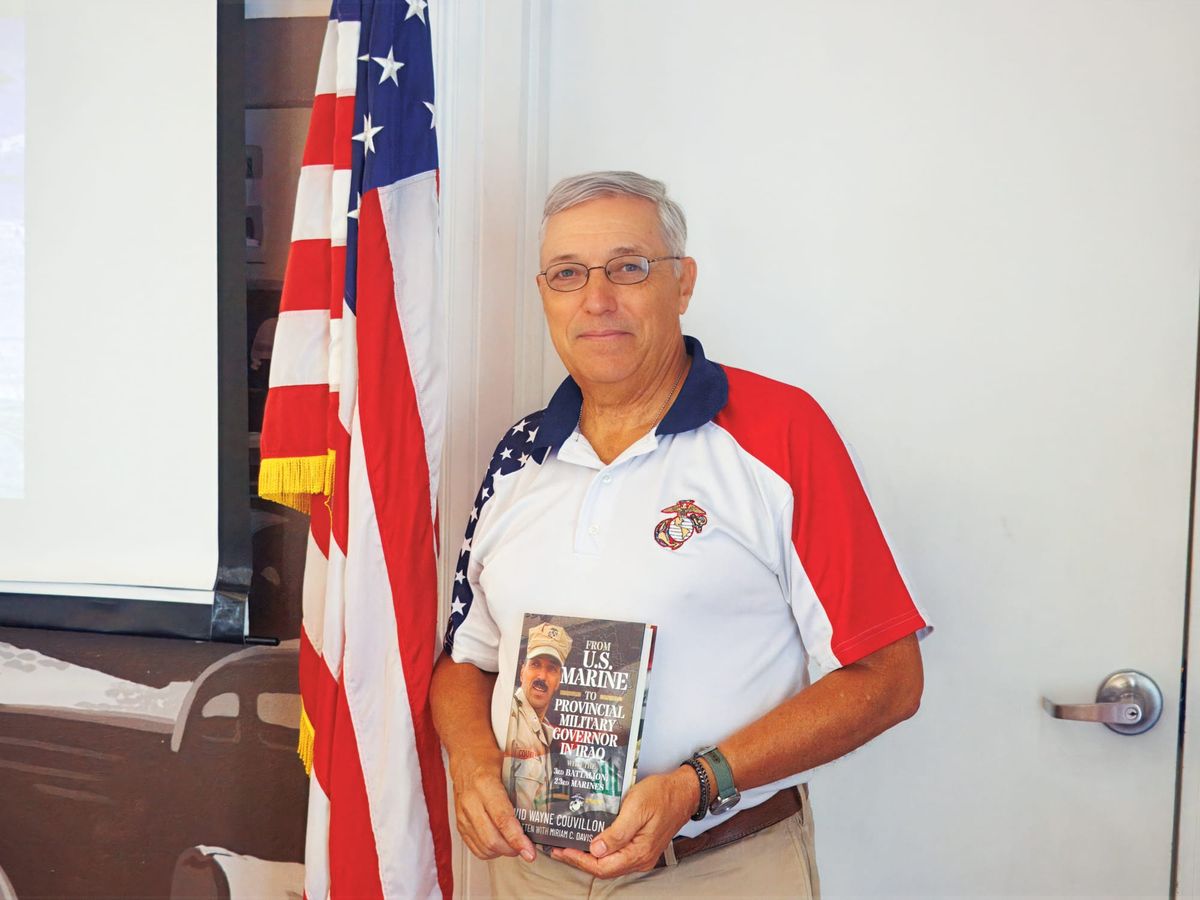
He tells the story in his memoir, "From U.S. Marine to Provincial Military Governor in Iraq: With the 3rd Battalion, 23rd Marines," written with Miriam C. Davis and published by Pen & Sword.
Al-Kut, the provincial capital, had a reputation as one of the deadliest cities in Iraq, he said. Saddam had emptied the prisons before the invasion. Tribes were picking old fights back up. Fighting with Iraqi troops hadn't stopped.
What Couvillon had going for him was the kind of unit he led. Reservists train part time and hold regular jobs the rest of the year.
"Because we were reservists, I had lawyers," he said. "I had civil engineers, I had policemen, I had electricians, I had plant workers, I had farmers."
So he put them to work doing what they already knew. One of his officers had trained troopers for the Louisiana State Police. Couvillon told him to rebuild the police force. A young lawyer restarted the courts. Two doctors in the battalion got the looted hospitals running again.
Earning trust
Most people in the province were Shia, Couvillon said, and many remembered 1991. After the Gulf War, the Shia rose up against Saddam expecting American help that never came. Saddam's helicopters cut them down.
So the Marines had to earn trust a patrol at a time.
He told them to take off their sunglasses when they talked to people, so both sides could look each other in the eye. He asked them to grow mustaches, because in that part of the world a man without facial hair isn't seen as old enough to be listened to. He said about 70% did. Once the fighting eased, he let them walk patrols without their helmets and flak jackets.
"Carry crayons, colored books, candy, food," he said he told them. "And when you see the kids, stop and play with them."
His thinking was that a parent who saw a Marine being good to their kid would look at the Marines a little differently.
Schools, a council and an election
Couvillon reopened the schools, with girls in the morning and boys in the afternoon. He said the afternoon slot kept young men busy and out of trouble.
He set up a provincial council where every group got one seat and one vote. Council members had never run a meeting where people actually voted, he said. Under Saddam, the man in charge told everyone what to do. So he taught them to write an agenda, debate and vote. When people were afraid to raise their hands, he switched to a secret ballot.
He picked a respected Iraqi judge, once exiled by Saddam, to serve as the Iraqi governor alongside him.
Then Baghdad told him not to hold local elections. He had one scheduled in the town of Numaniyah in June 2003 and held it anyway.
"I didn't get that message," he said.
He said about 98% of the people voted, women and men.
He also started two television stations, two newspapers and two radio stations, and he didn't tell them what to say.
"Against me, for me, whatever," he said. "I believe in the First Amendment."
Coming home
Couvillon said that by the time his battalion handed the province to Ukrainian troops, Wasit had gone from one of the most dangerous provinces in Iraq to one of the safest.
"I brought all of my Marines home," he said. "I had no deaths. I did have some wounded."
The years since have been harder. He said eight Marines from his battalion have died by suicide since they came home.
"That's a hard thing," he said.
He still keeps up with many of them, now in their 40s. He also hears from Iraqis who call, email and message him for advice.
He said he wrote the book because most Americans never heard about the good work done in Iraq. He also wanted his grandchildren to have a record of it.
"It was absolutely the most exciting time of my life," he said. "I actually felt I made a difference in the world."
Veterans Day celebration Sunday
The West Baton Rouge Museum, where Couvillon gave his talk, hosts its Veterans Celebration on Sunday, Nov. 8.
The program starts at 11 a.m., with music by Jude Quebedeaux at 11:30 featuring the TC Dance Club International.
The ceremony begins at 1 p.m. with a welcome from Parish President Jason Manola. Port Allen Mayor Terecita Pattan will lead the Pledge of Allegiance, Parish Councilman Atley Walker will give the veterans prayer, and U.S. Air Force Sgt. Felicie Jackson will sing the national anthem.
The Victory Belles perform at 1:30. The Florida Street Blowhards follow at 2:30 with an Armed Forces medley, and the day closes with the car show awards.
The antique car show is open to civilian and military vehicles. Registration starts at 10 a.m. and costs $5, cash only, with no bills larger than $20. Proceeds go toward next year's celebration, and awards go to the best civilian and best military vehicle.
Veterans in crisis, or anyone worried about one, can reach the Veterans Crisis Line by dialing 988 and pressing 1, or by texting 838255.